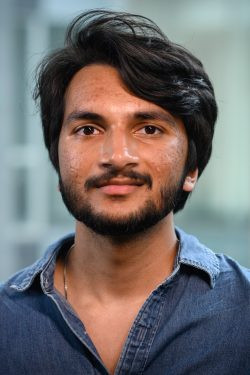
Chaitanya Srinivasan

Machine Learning · Theis lab · Helmholtz Munich

Chaitanya Srinivasan

I am a Machine Learning PhD candidate in Fabian Theis's lab at Helmholtz Munich and TUM. I am also a member of the Munich Center for Machine Learning. I work on biological foundation models and generative AI for health.

Previously I was a Senior NLP Engineer at JPMorgan Chase building large-scale production retrieval, semantic search, and agentic LLM systems. Before that I spent eight years at Carnegie Mellon's School of Computer Science with Andreas Pfenning, developing models for brain cell-type-specific regulatory elements, enhancer evolution across 222 mammalian genomes, and the cell-type context of GWAS signal in complex neural traits and disorders.

* denotes equal contribution. I am a member of the Zoonomia Consortium; beyond the Science paper listed below, I am a consortium author on ten further papers in the 2023 Science package, which are not itemised here. Full record on Google Scholar.

2026

Fine-mapping candidate neuropsychiatric regulatory variants using cell type-aware comparative genomics

BaDoi N. Phan, Alyssa J. Lawler, Jing He, Ashley R. Brown, Irene M. Kaplow, Amanda Kowalczyk, Chaitanya Srinivasan, Grant A. Fox, Rajee Ganesan, Ziheng Chen, Daniel E. Schäffer, William R. Stauffer, Andreas R. Pfenning

bioRxiv DOI

CTACIT, the Cell Type-Aware Conservation Inference Toolkit, folds sequence conservation together with cell-type-specific open chromatin from a handful of mammals to impute regulatory function across hundreds more, yielding higher heritability enrichment and more fine-mapped variants on neuropsychiatric loci than nucleotide conservation or human chromatin alone. In vivo reporter assays validate predicted enhancers carrying risk variants near DRD2.

2026

A cautionary tale of self-supervised learning for imaging biomarkers: Alzheimer's disease case study

Maxwell Reynolds, Chaitanya Srinivasan, Vijay Cherupally, Michael J. Leone, Ke Yu, Li Sun, Tigmanshu Chaudhary, Andreas R. Pfenning, Kayhan Batmanghelich

arXiv 2601.16467

Off-the-shelf SSL on structural MRI loses to hand-crafted FreeSurfer features. We fold those features into the contrastive objective (R-NCE), then test the resulting brain-age gap for heritability and GWAS signal rather than trusting benchmark accuracy.

2025

Machine learning identification of enhancers in the rhesus macaque genome

Jing He, BaDoi N. Phan, Willa G. Kerkhoff, …, Chaitanya Srinivasan, Michael J. Leone, …, Leah C. Byrne, Andreas R. Pfenning, William R. Stauffer 21 authors

Neuron DOI

Cell-type-specific open chromatin in macaque prefrontal cortex, ranked by sequence models; the top layer-3 pyramidal candidate was packaged into AAV and drove functional expression in vivo.

2025

The cell-type-specific genetic architecture of chronic pain in brain and dorsal root ganglia

Sylvanus Toikumo, Marc Parisien, Michael J. Leone, Chaitanya Srinivasan, …, Andreas R. Pfenning, …, Stephen G. Waxman, Henry R. Kranzler 17 authors

Journal of Clinical Investigation DOI

A 1.2M-subject chronic pain GWAS intersected with single-cell transcriptomic and chromatin data from human brain and dorsal root ganglia, localizing heritability to glutamatergic neurons and C-fibers.

2023

Relating enhancer genetic variation across mammals to complex phenotypes using machine learning

Irene M. Kaplow*, Alyssa J. Lawler*, Daniel E. Schäffer*, Chaitanya Srinivasan, …, Zoonomia Consortium, …, Kerstin Lindblad-Toh, Wynn K. Meyer, Andreas R. Pfenning 17 authors

Science DOI bioRxiv

TACIT associates open chromatin regions with species-level phenotypes by predicting tissue-specific regulatory activity across hundreds of mammalian genomes, recovering brain-size-associated enhancers near genes mutated in microcephaly and macrocephaly.

2023

Integrative multi-dimensional characterization of striatal projection neuron heterogeneity in adult brain

Jenesis Gayden, Stephanie Puig, Chaitanya Srinivasan, BaDoi N. Phan, Ghada Abdelhady, Silas A. Buck, Mackenzie C. Gamble, Hugo A. Tejeda, Yan Dong, Andreas R. Pfenning, Ryan W. Logan, Zachary Freyberg

bioRxiv DOI

RNAscope spatial mapping combined with single-nucleus multi-omics resolves striatal projection neurons that co-express multiple dopamine receptors into spatially distinct subtypes.

2022

Molecular rhythm alterations in prefrontal cortex and nucleus accumbens associated with opioid use disorder

Xiangning Xue, Wei Zong, Jill R. Glausier, Sam-Moon Kim, Micah A. Shelton, BaDoi N. Phan, Chaitanya Srinivasan, Andreas R. Pfenning, George C. Tseng, David A. Lewis, Marianne L. Seney, Ryan W. Logan

Translational Psychiatry DOI

Using time of death as a clock, transcriptional rhythms in DLPFC and nucleus accumbens diverge sharply between subjects with opioid use disorder and unaffected comparisons.

2021

Addiction-associated genetic variants implicate brain cell type- and region-specific cis-regulatory elements in addiction neurobiology

Chaitanya Srinivasan*, BaDoi N. Phan*, Alyssa J. Lawler, Easwaran Ramamurthy, Michael Kleyman, Ashley R. Brown, Irene M. Kaplow, Morgan E. Wirthlin, Andreas R. Pfenning

Journal of Neuroscience Co-first author DOI bioRxiv

Stratified LD score regression against open-chromatin annotations across human and mouse brain, plus sequence models that score individual risk variants for predicted regulatory effect in specific neuronal populations.

2021

Transcriptional alterations in dorsolateral prefrontal cortex and nucleus accumbens implicate neuroinflammation and synaptic remodeling in opioid use disorder

Marianne L. Seney, Sam-Moon Kim, Jill R. Glausier, …, BaDoi N. Phan, Chaitanya Srinivasan, Andreas R. Pfenning, …, Zachary Freyberg, Ryan W. Logan 15 authors

Biological Psychiatry DOI

Postmortem RNA-seq across two reward-circuit regions in opioid use disorder, with LD score regression linking the differentially expressed modules to psychiatric GWAS heritability.